

"What happens if we pause SEO for a while?" It's one of the most common questions we hear from dental practices, and it's a fair one. Budgets get tight, priorities shift, and if things look fine this month, it's easy to assume they'll look fine next month too.
So we tested this. We followed a group of practices for six months after they stopped active SEO and compared it to the six months before. The short answer: nothing crashed. But almost every practice saw the same slow fade, and it showed up in the numbers that matter most, like phone calls and local rankings, long before anyone noticed it in traffic reports.
What we measured
We compared six dental practices' Google Search Console, Google Analytics, and Google Business Profile data for the six months before they paused SEO and the six months after. All six were established practices with years of SEO behind them, which matters. They had strong rankings and content to coast on.
What changed
1. More people saw them. Fewer called.
This was the most surprising pattern. Several practices actually showed up in more searches after pausing. At one, Google impressions rose more than 60%. At another, they grew 38%.
But that visibility didn't turn into patients. At one practice, impressions jumped 38% while clicks stayed flat. At the two practices where we could see website calls, they fell 18% and 41%. The new visibility came mostly from broad, informational searches, not from people looking for a dentist nearby.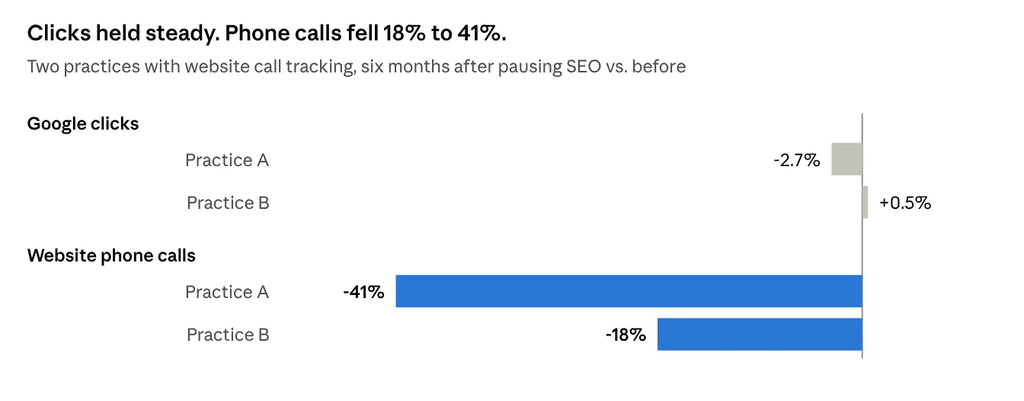
2. Local rankings slipped first.
The searches that bring in new patients, like "dentist" plus a suburb name, were the first to slide. One practice dropped from around position 5 to position 12 for its most important local search, falling off the first page. Another had 24 of 25 tracked keywords on page one at its peak. Six months later, 17 were left.
Competitors don't pause. When one practice stops, the practices still investing quietly move up.
3. The Google profile went quiet.
None of the six practices posted to their Google Business Profile after pausing. At one, profile search views fell 18% and direction requests fell 13%. A profile that looks inactive gives Google, and patients, less reason to choose it.
4. Content aged, and some pages disappeared.
No new content was added at any of the six practices. Over time, some pages dropped out of search results entirely, including doctor bio pages and a page answering a popular question about weekend hours. Visitors who did arrive spent less time on the site. The average time on site fell by 20% to 30% at most practices.
What held up
To be fair, not everything went down. Strong SEO work keeps paying off for a while, which is exactly why a pause can feel safe at first.
- Website visits held or grew at most practices, up 10% to 18% at three of them.
- Branded searches stayed strong. Patients who already knew a practice's name still found it easily.
The catch is that these results come from work already done. They hold steady for a while, but nothing is adding to them, and the local rankings underneath are already slipping.
Thinking about pausing? Protect these first.
Sometimes a pause is the right call. If you're considering one, keep the things that decay fastest from going dark:
- Keep your Google Business Profile active. Post regularly, add fresh photos, and keep hours accurate. It's the first thing to go quiet and the first place patients look.
- Watch your local rankings, not just traffic. Traffic can look fine while "dentist near me" and suburb searches slip.
- Keep tracking your calls and bookings. That's the earliest sign something is changing, months before it shows up as fewer new patients.
- Protect your best pages. Don't let doctor bios, service pages, and FAQ pages go out of date or disappear.
- Make sure you own your accounts. Your website, domain, Google Business Profile, and analytics should all be in your name, whatever you decide.